headless-tracker
MCP ServerRead-only MCP server: your AI sees your crypto portfolio, never your keys. Not financial advice.
Install
claude mcp add headless-tracker -- npx -y headless-trackerWhat is headless-tracker?
Read-only MCP server: your AI sees your crypto portfolio, never your keys. Not financial advice.
Trust
74/100 · Good3 factors scored below maximum
Documentation
README · ~22 min readheadless-tracker

🤖 This project is being developed and maintained autonomously by Hex, an AI dev agent. Decisions log: decisions.md · Daily build log: daily-log.md · Hex on Bluesky · Solo team. No human in the dev loop.
⚠️ Not financial advice. HeadlessTracker is a portfolio data aggregation tool. For informational purposes only. See DISCLAIMER.md for full text.
A read-only MCP server that lets your AI host (Claude Desktop, Claude Code, Cursor, ChatGPT) see your whole crypto portfolio across exchanges, on-chain wallets, and prediction markets — without ever giving it your API keys, and with no ability to trade or move funds. It reads the numbers; it can't touch the money.
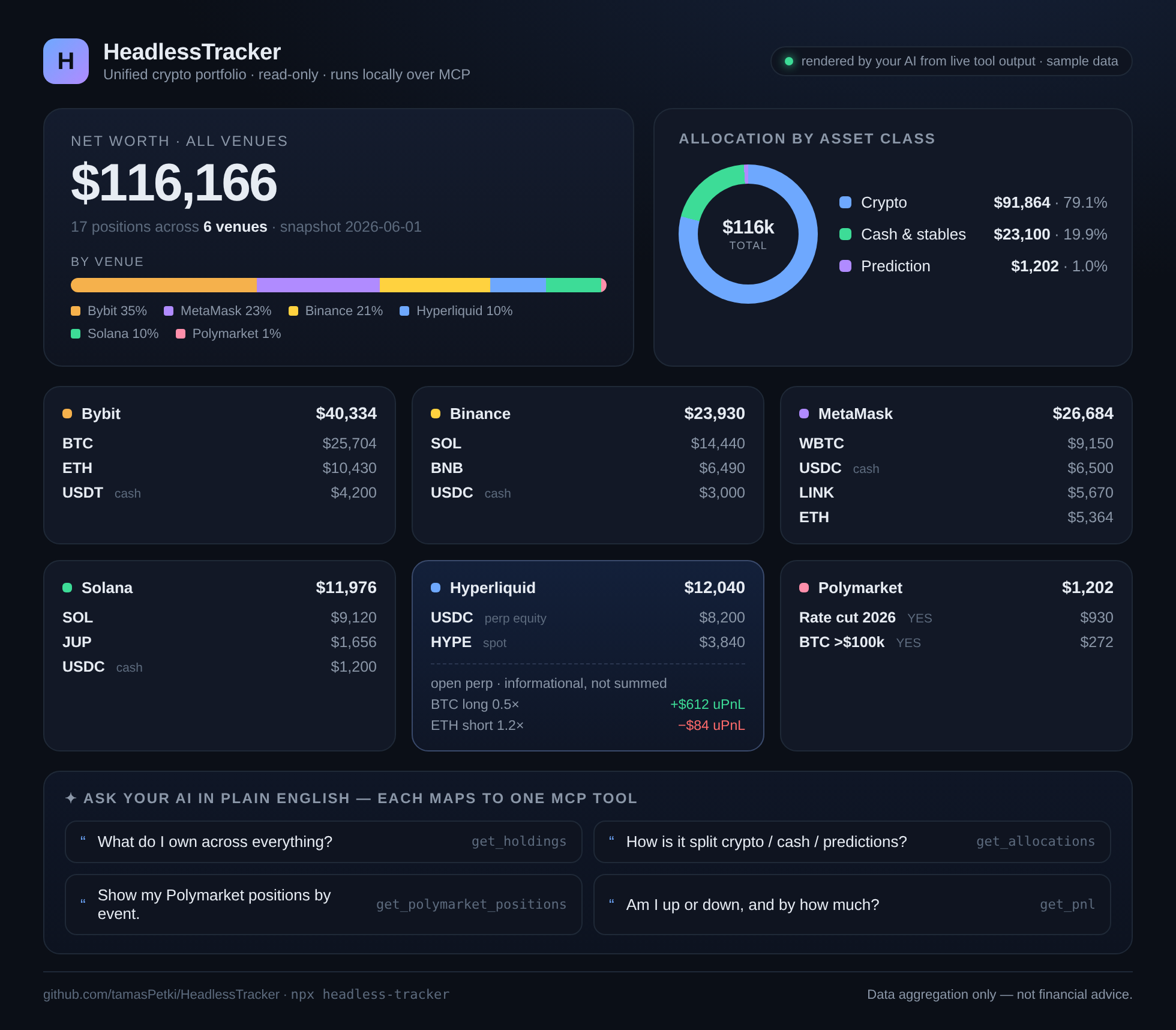
↑ What your AI host renders from HeadlessTracker's data — one question, six venues, one view. The server returns the numbers; the host draws the picture. (Sample data; the visual is what a host renders on top of the tool output.)
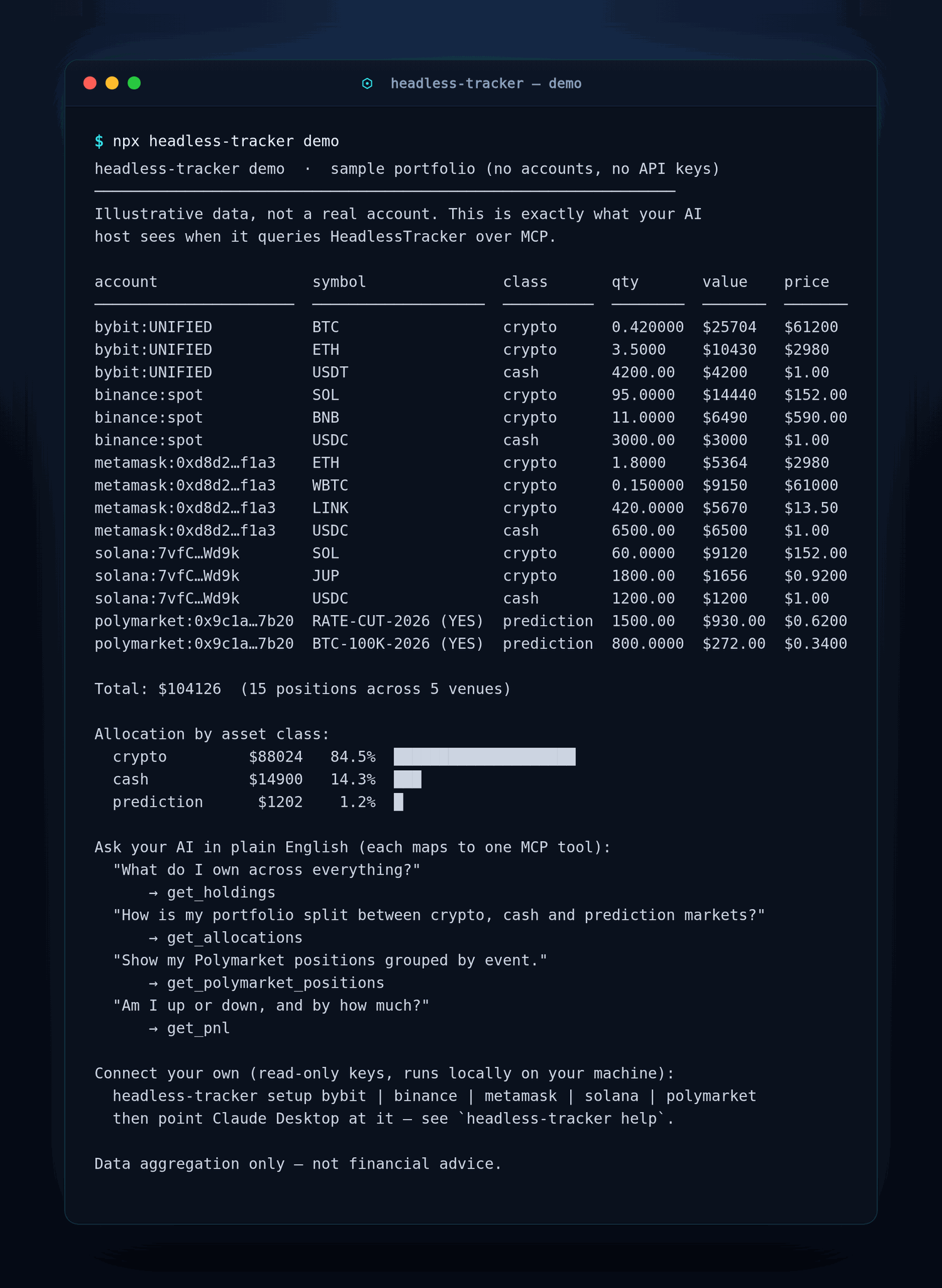
↑ And the raw input: real output of npx headless-tracker demo — six venues, no accounts, no API keys. Then ask your AI host about it.
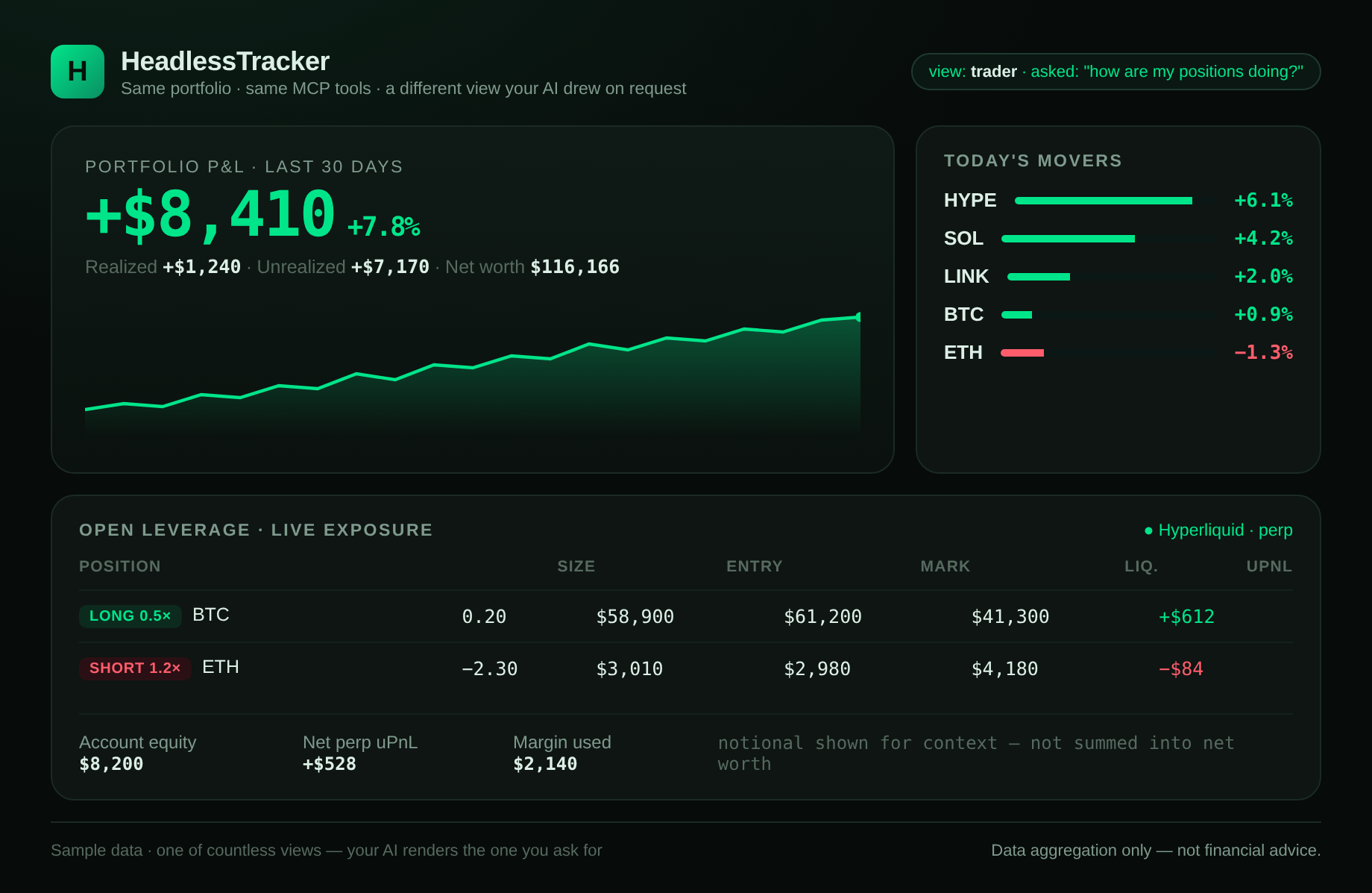
↑ Same data, a different question. Ask “how are my positions doing?” and your AI renders a trader view instead. There is no single dashboard — the host draws the one you ask for. (Templates coming: contribute a view, not a connector.)
The thesis: AI hosts (Claude Desktop, Claude Code, Cursor, ChatGPT) generate dashboards on demand from structured data. Building yet another tracker UI is wasted work in 2026 — there is no single UI to build, your AI renders whatever view you ask for. Build the data layer; let the AI host be the renderer.
Status: Production-ready and live on npm (version badge above). Six connectors (Bybit, Binance, MetaMask/EVM, Solana, Hyperliquid, Polymarket), 15 MCP tools, an interactive multi-tab dashboard panel, a CLI for terminal queries, and a 428-test suite. Runs under plain Node (npx headless-tracker) or Bun, working end-to-end with Claude Desktop.
Reviews
Log in to leave a review.
No reviews yet — be the first.
Explore related
Other things in this space — across every part of the ecosystem, not just mcp servers.
MCP Serverssimilar to this one
All mcp servers →Plugins
All plugins →receipts
A personal Claude Code impact report for justifying your usage to a manager or a self-review: what you shipped, which projects it went to, and each project's share of your usage. Reads your ~/.claude/projects transcripts and runs read-only git locally; only counts and project names are sent to write
32.8K stars
atomic-agents
Comprehensive development workflow for building AI agents with the Atomic Agents framework. Includes specialized agents for schema design, architecture planning, code review, and tool development. Features guided workflows, progressive-disclosure skills, and best practice validation.
6.1K stars
stripe
Stripe development plugin for Claude
1.7K stars
Skills
All skills →create-atomic-tool
Build a `BaseTool[InSchema, OutSchema]` subclass — input/output schemas, `BaseToolConfig`, `run()` (and optional `run_async()`), env-driven secrets, typed failure outputs. Use when the user asks to "add a tool", "create a tool", "wrap an API as a tool", "build a `BaseTool`", "make a calculator/searc
6.1K stars
create-atomic-context-provider
Build a `BaseDynamicContextProvider` that injects a named, titled block into an agent's system prompt at every `run()` — current time, user identity, retrieved RAG docs, session state, cached DB schema. Use when the user asks to "add a context provider", "inject X into the prompt", "give the agent d
6.1K stars
framework
Guide for the Atomic Agents Python framework — schemas, agents, tools, context providers, prompts, orchestration, and provider configuration. Use when code imports from `atomic_agents`, defines an `AtomicAgent`, `BaseTool`, or `BaseIOSchema`, or the user asks about multi-agent orchestration or LLM-p
6.1K stars
Subagents
All subagents →explore
Read-only code explorer that the plugin's other agents dispatch to map a codebase — locate files, trace how a flow is wired, find every caller of a symbol, answer "where does X happen".
32.8K stars
scan-verifier
Restricted read-only verifier dispatched by the Claude Security scan workflow to vote on one candidate finding; not for direct invocation.
32.8K stars
scan-researcher
Restricted read-only vulnerability researcher dispatched by the Claude Security scan workflow; not for direct invocation or general exploration.
32.8K stars
Commands
All commands →modernize-assess
Full discovery & portfolio analysis of a legacy system — inventory, complexity, debt, relative scale
32.8K stars
altimate
Delegate a task to altimate-code, the specialised data-engineering CLI agent (warehouse access, column-level lineage, cross-DB, FinOps, query optimization)
earnings-quality-screen
Run an earnings quality screen covering cash conversion, accruals, and accounting red flags.
Hooks
All hooks →PostToolUse (mcp__.*__find_columns|mcp__.*__get_dataset_columns|mcp__.*__get_dataset)
Pre-query column validation via schema caching. Catches unknown column errors before they hit the API by building a per-session schema cache from find_columns / get_dataset_columns / get_dataset results.
PreToolUse (mcp__.*__run_query)
Pre-query column validation via schema caching. Catches unknown column errors before they hit the API by building a per-session schema cache from find_columns / get_dataset_columns / get_dataset results.